
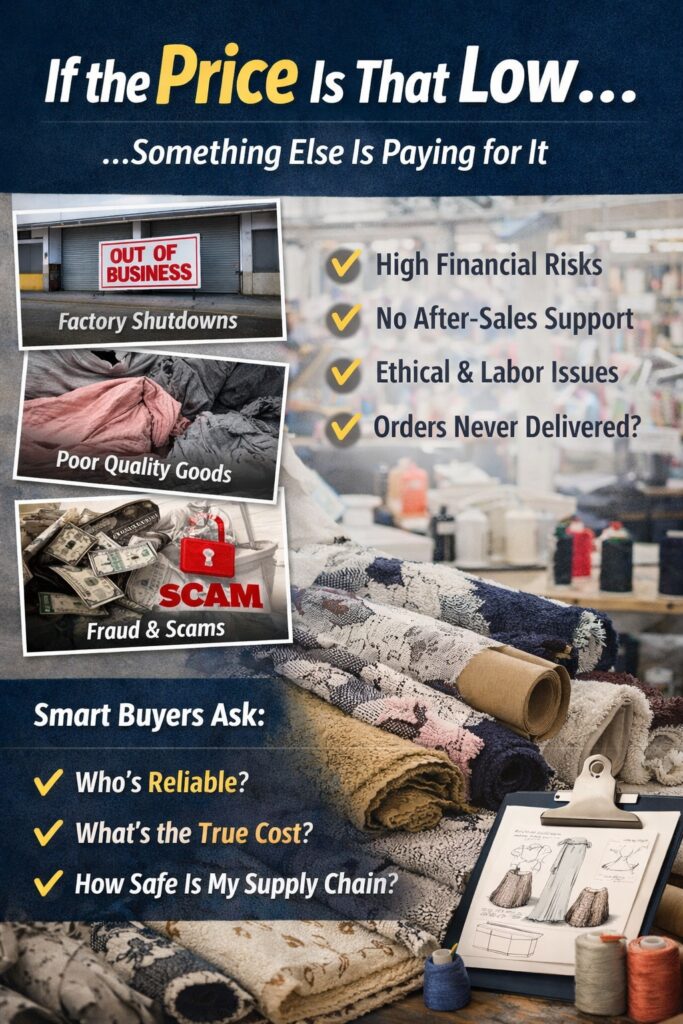
A Practical Guide for Buyers Navigating Today’s Sourcing Market
✉️ A Note We Often Share with Clients
Subject: If the Price Is That Low, Something Else Is Paying for It
Dear Client,
When you share a target price with us, we always take it seriously.
But at the same time, we believe transparency matters more than simply saying “yes.”
Instead of pushing a quick quote, we’d like to share a few real situations we’ve seen in the market—so you can make a more informed decision.
⚠️ What “Too Low Pricing” Often Means in Reality
1. Factories That Don’t Rely on Product Profit
Some factories are not making money from production at all.
They use customer payments as cash flow for high-interest lending or other financial activities. To attract as much cash as possible, they offer unusually low prices.
The risk:
- delayed payments to suppliers
- unstable operations
- sudden shutdowns
👉 Once something goes wrong, recovery is extremely difficult.
2. One-Time Business Models (No Long-Term Responsibility)
Some suppliers operate with a “ship once and disappear” mindset.
To compensate for low pricing, they may:
- reduce actual shipment quantity
- downgrade product quality
- avoid any after-sales support
👉 After delivery, communication becomes minimal or non-existent.
3. Using Orders as Interest-Free Financing
This is more common than most buyers expect.
Suppliers attract multiple orders with low pricing, collect deposits, and delay production for months.
Eventually:
- they may cancel the order
- or return the money after using it
👉 Technically not fraud—but effectively using your capital for free.
4. Extremely Low Labor Cost Sources
In rare cases, low pricing may come from non-standard labor systems, including cooperation with facilities where labor costs are unusually low.
👉 This raises not only quality concerns, but also ethical and compliance risks, especially for brands selling in North America and Europe.
5. Clearance or Cancelled Orders
Sometimes, low prices are real—but situational.
For example:
- cancelled export orders
- overstock inventory
- urgent cash recovery
👉 These deals are usually:
- limited in quantity
- non-repeatable
- inconsistent in specs
6. Direct Fraud (Worst-Case Scenario)
Unfortunately, some suppliers:
- take deposits
- never deliver
- disappear completely
👉 While less common, the impact is severe.
🧭 How Smart Buyers Evaluate Price Today
In today’s sourcing environment, experienced buyers are shifting focus from:
❌ “Who is the cheapest?”
➡️ to
✅ “Who is the most reliable at a reasonable cost?”
Key evaluation factors include:
- supplier stability
- production transparency
- communication consistency
- quality control systems
- after-sales support
🤝 Our Approach at JIAXING SL TEXTILE
We don’t aim to be the lowest price in the market.
We aim to be:
- consistent in quality
- transparent in costing
- reliable in delivery
- responsive in communication
Because in the long run, a stable supply chain always costs less than a risky one.
FAQ – Frequently Asked Questions
Q1: Is a low price always a red flag?
Not always. But it should always be questioned. Understanding why the price is low is critical.
Q2: How can I verify if a supplier is reliable?
Check production capacity, request samples, review past shipments, and evaluate communication responsiveness.
Q3: What’s the safest way to start with a new supplier?
Begin with a small trial order and clear specifications before scaling up.
Q4: Can low-cost suppliers still be good partners?
Yes—but only if their pricing is based on efficiency, not shortcuts or financial instability.


